
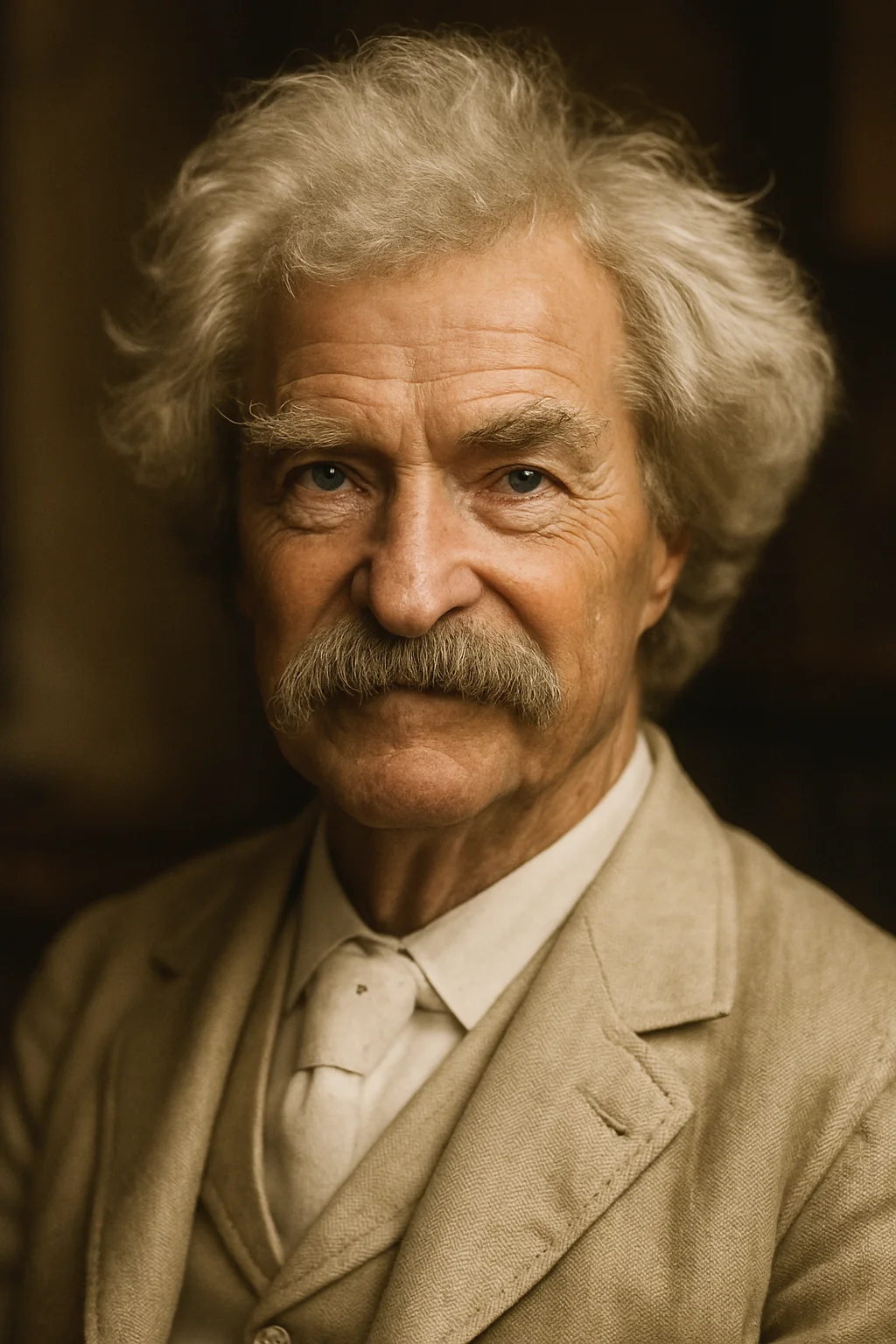
"“A God who could make good children as easily a bad, yet preferred to make bad ones; who could have made every one of them happy, yet never made a single happy one; who made them prize their bitter life, yet stingily cut it short; who gave his angels eternal happiness unearned, yet required his other children to earn it; who gave is angels painless lives, yet cursed his other children with biting miseries and maladies of mind and body; who mouths justice, and invented hell--mouths mercy, and invented hell--mouths Golden Rules and forgiveness multiplied by seventy times seven, and invented hell; who mouths morals to other people, and has none himself; who frowns upon crimes, yet commits them all; who created man without invitation, then tries to shuffle the responsibility for man's acts upon man, instead of honorably placing it where it belongs, upon himself; and finally, with altogether divine obtuseness, invites his poor abused slave to worship him!”"
— Mark Twain
A God Who Could Make Good Children As Easily A Bad
“A God who could make good children as easily a bad, yet preferred to make bad ones; who could have made every one of them happy, yet never made a single happy one; who made them prize their bitter life, yet stingily cut it short; who gave his angels eternal happiness unearned, yet required his other children to earn it; who gave is angels painless lives, yet cursed his other children with biting miseries and maladies of mind and body; who mouths justice, and invented hell--mouths mercy, and invented hell--mouths Golden Rules and forgiveness multiplied by seventy times seven, and invented hell; who mouths morals to other people, and has none himself; who frowns upon crimes, yet commits them all; who created man without invitation, then tries to shuffle the responsibility for man's acts upon man, instead of honorably placing it where it belongs, upon himself; and finally, with altogether divine obtuseness, invites his poor abused slave to worship him!”
Similar Quotes
“That bodies should be lent us, while they can afford us pleasure, assist us in acquiring knowledge, or doing good to our fellow creatures, is a kind and benevolent act of God - when they become unfit for these purposes and afford us pain instead of pleasure-instead of an aid, become an encumbrance and answer none of the intentions for which they were given, it is equally kind and benevolent that a way is provided by which we may get rid of them. Death is that way.”
“It sounds like a fairy-tale, but not only that; this story of what man by his science and practical inventions has achieved on this earth, where he first appeared as a weakly member of the animal kingdom, and on which each individual of his species must ever again appear as a helpless infant... is a direct fulfilment of all, or of most, of the dearest wishes in his fairy-tales. All these possessions he has acquired through culture. Long ago he formed an ideal conception of omnipotence and omniscience which he embodied in his gods. Whatever seemed unattainable to his desires - or forbidden to him - he attributed to these gods. One may say, therefore, that these gods were the ideals of his culture. Now he has himself approached very near to realizing this ideal, he has nearly become a god himself. But only, it is true, in the way that ideals are usually realized in the general experience of humanity. Not completely; in some respects not at all, in others only by halves. Man has become a god by means of artificial limbs, so to speak, quite magnificent when equipped with all his accessory organs; but they do not grow on him and they still give him trouble at times... Future ages will produce further great advances in this realm of culture, probably inconceivable now, and will increase man's likeness to a god still more.”
“...But I own that I cannot see as plainly as others do, and as I should wish to do, evidence of design and beneficence on all sides of us. There seems to me too much misery in the world. I cannot persuade myself that a beneficent and omnipotent God would have designedly created the Ichneumonidæ with the express intention of their feeding within the living bodies of Caterpillars, or that a cat should play with mice... I feel most deeply that the whole subject is too profound for the human intellect. A dog might as well speculate on the mind of Newton. Let each man hope and believe what he can.”
“...when he looks at Beauty in the only way that Beauty can be seen - only then will it become possible for him to give birth not to images of virtue (because he's in touch with no images), but to true virtue [arete] (because he is in touch with true Beauty). The love of the gods belongs to anyone who has given to true virtue and nourished it, and if any human being could become immortal, it would be he.”
I cannot imagine a God who rewards and punishes the objects of his creation, whose purposes are modeled after our own -- a God, in short, who is but a reflection of human frailty. Neither can I believe that the individual survives the death of his body, although feeble souls harbor such thoughts through fear or ridiculous egotisms.
“I believe that if one man were to live out his life fully and completely, were to give form to every feeling, expression to every thought, reality to every dream - I believe that the world would gain such a fresh impulse of joy that we would forget all the maladies of medievalism, and return to the Hellenic ideal - to something finer, richer, than the Hellenic ideal, it may be. But the bravest man amongst us is afraid of himself. The mutilation of the savage has its tragic survival in the self-denial that mars our lives. We are punished for our refusals.”