
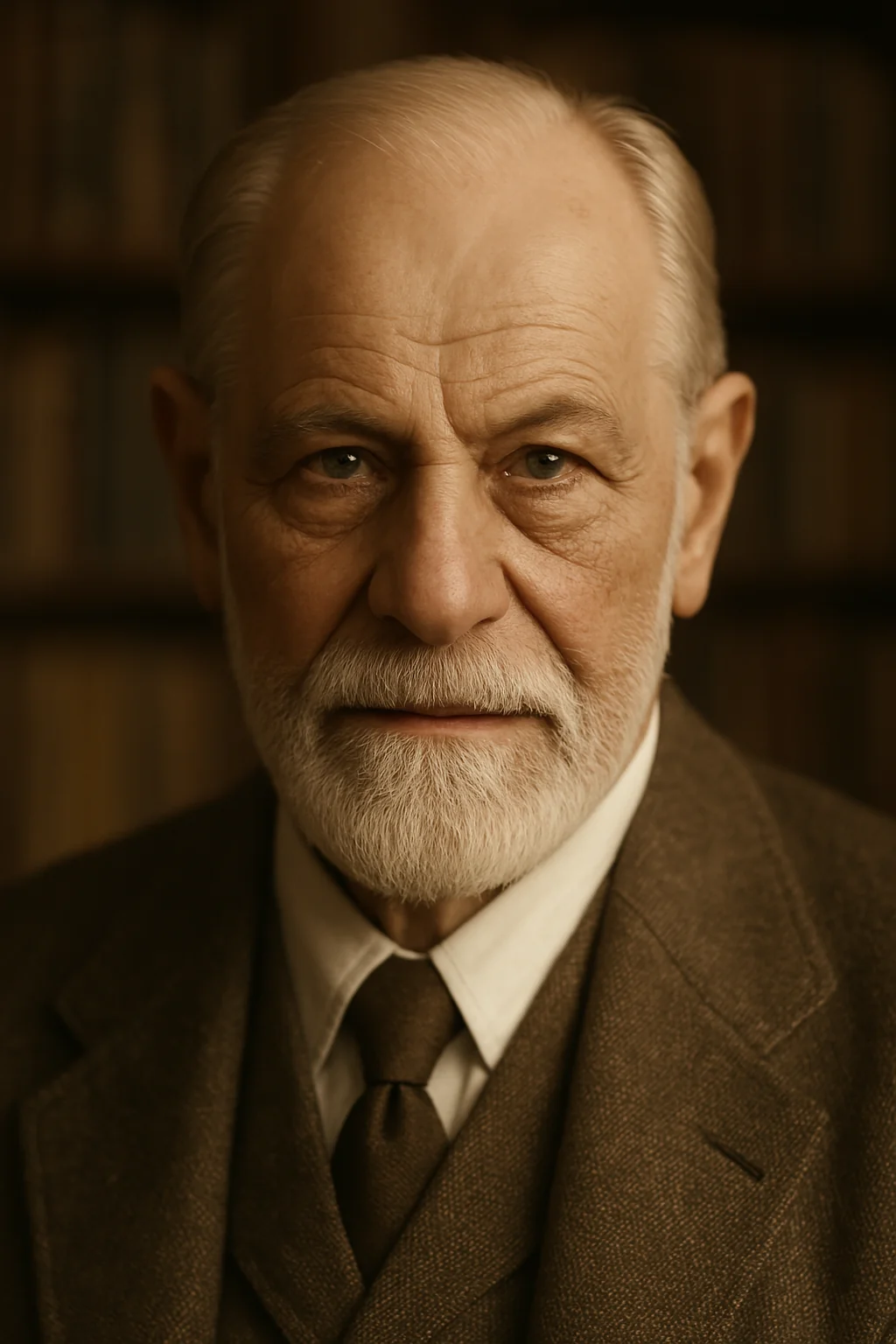
"“No other technique for the conduct of life attaches the individual so firmly to reality as laying emphasis on work; for his work at least gives him a secure place in a portion of reality, in the human community. The possibility it offers of displacing a large amount of libidinal components, whether narcissistic, aggressive or even erotic, on to professional work and on to the human relations connected with it lends it a value by no means second to what it enjoys as something indispensible to the preservation and justification of existence in society. Professional activity is a source of special satisfaction if it is a freely chosen one — if, that is to say, by means of sublimation, it makes possible the use of existing inclinations, of persisting or constitutionally reinforced instinctual impulses. And yet, as a path to happiness, work is not highly prized by men. They do not strive after it as they do after other possibilities of satisfaction. The great majority of people only work under the stress of necessity, and this natural human aversion to work raises most difficult social problems.”"
— Sigmund Freud
No Other Technique For The Conduct Of Life
“No other technique for the conduct of life attaches the individual so firmly to reality as laying emphasis on work; for his work at least gives him a secure place in a portion of reality, in the human community. The possibility it offers of displacing a large amount of libidinal components, whether narcissistic, aggressive or even erotic, on to professional work and on to the human relations connected with it lends it a value by no means second to what it enjoys as something indispensible to the preservation and justification of existence in society. Professional activity is a source of special satisfaction if it is a freely chosen one — if, that is to say, by means of sublimation, it makes possible the use of existing inclinations, of persisting or constitutionally reinforced instinctual impulses. And yet, as a path to happiness, work is not highly prized by men. They do not strive after it as they do after other possibilities of satisfaction. The great majority of people only work under the stress of necessity, and this natural human aversion to work raises most difficult social problems.”
Similar Quotes
“Productiveness is your acceptance of morality, your recognition of the fact that you choose to live--that productive work is the process by which man's consciousness controls his existence, a constant process of acquiring knowledge and shaping matter to fit one's purpose, of translating an idea into physical form, of remaking the earth in the image of one's values--that all work is creative work if done by a thinking mind, and no work is creative if done by a blank who repeats in uncritical stupor a routine he has learned from others--that your work is yours to choose, and the choice is as wide as your mind, that nothing more is possible to you and nothing less is human--that to cheat your way into a job bigger than your mind can handle is to become a fear-corroded ape on borrowed motions and borrowed time, and to settle down into a job that requires less than your mind's full capacity is to cut your motor and sentence yourself to another kind of motion: decay--that your work is the process of achieving your values, and to lose your ambition for values is to lose your ambition to live--that your body is a machine, but your mind is its driver, and you must drive as far as your mind will take you, with achievement as the goal of your road--that the man who has no purpose is a machine that coasts downhill at the mercy of any boulder to crash in the first chance ditch, that the man who stifles his mind is a stalled machine slowly going to rust, that the man who lets a leader prescribe his course is a wreck being towed to the scrap heap, and the man who makes another man his goal is a hitchhiker no driver should ever pick up--that your work is the purpose of your life, and you must speed past any killer who assumes the right to stop you, that any value you might find outside your work, any other loyalty or love, can be only travelers you choose to share your journey and must be travelers going on their own power in the same direction.”
“When, therefore, we maintain that pleasure is the end, we do not mean the pleasures of profligates and those that consist in sensuality, as is supposed by some who are either ignorant or disagree with us or do not understand, but freedom from pain in the body and from trouble in the mind. For it is not continuous drinkings and revelings, nor the satisfaction of lusts, nor the enjoyment of fish and other luxuries of the wealthy table, which produce a pleasant life, but sober reasoning, searching out the motives for all choice and avoidance, and banishing mere opinions, to which are due the greatest disturbance of the spirit.”
“Those whose acquaintance with scientific research is derived chiefly from its practical results easily develop a completely false notion of the mentality of the men who, surrounded by a skeptical world, have shown the way to kindred spirits scattered wide through the world and through the centuries. Only one who has devoted his life to similar ends can have a vivid realization of what has inspired these men and given them the strength to remain true to their purpose in spite of countless failures. It is cosmic religious feeling that gives a man such strength. A contemporary has said, not unjustly, that in this materialistic age of ours the serious scientific workers are the only profoundly religious people.”
“The great source of both the misery and disorders of human life, seems to arise from over-rating the difference between one permanent situation and another. Avarice over-rates the difference between poverty and riches: ambition, that between a private and a public station: vain-glory, that between obscurity and extensive reputation. The person under the influence of any of those extravagant passions, is not only miserable in his actual situation, but is often disposed to disturb the peace of society, in order to arrive at that which he so foolishly admires. The slightest observation, however, might satisfy him, that, in all the ordinary situations of human life, a well-disposed mind may be equally calm, equally cheerful, and equally contented. Some of those situations may, no doubt, deserve to be preferred to others: but none of them can deserve to be pursued with that passionate ardour which drives us to violate the rules either of prudence or of justice; or to corrupt the future tranquillity of our minds, either by shame from the remembrance of our own folly, or by remorse from the horror of our own injustice.”
“Listen to what is being preached today. Look at everyone around us. You've wondered why they suffer, why they seek happiness and never find it. If any man stopped and asked himself whether he's ever held a truly personal desire, he'd find the answer. He'd see that all his wishes, his efforts, his dreams, his ambitions are motivated by other men. He's not really struggling even for material wealth, but for the second-hander's delusion - prestige. A stamp of approval, not his own. He can find no joy in the struggle and no joy when he has succeeded. He can't say about a single thing: 'This is what I wanted because I wanted it, not because it made my neighbors gape at me'. Then he wonders why he's unhappy.”
“Actually, the substitution of the reality-principle for the pleasure-principle denotes no dethronement of the pleasure-principle, but only a safeguarding of it. A momentary pleasure, uncertain in its results, is given up, but only in order to gain in the new way an assured pleasure coming later. But the end psychic impression made by this substitution has been so powerful that it is mirrored in a special religious myth. The doctrine of reward in a future life for the—voluntary or enforced—renunciation of earthly lusts is nothing but a mythical projection of this revolution in the mind. In logical pursuit of this prototype, religions have been able to effect the absolute renunciation of pleasure in this life by means of the promise of compensation in a future life; they have not, however, achieved a conquest of the pleasure-principle this way. It is science which comes nearest to succeeding in this conquest; science, however, also offers intellectual pleasure during its work and promises practical gain at the end.”