
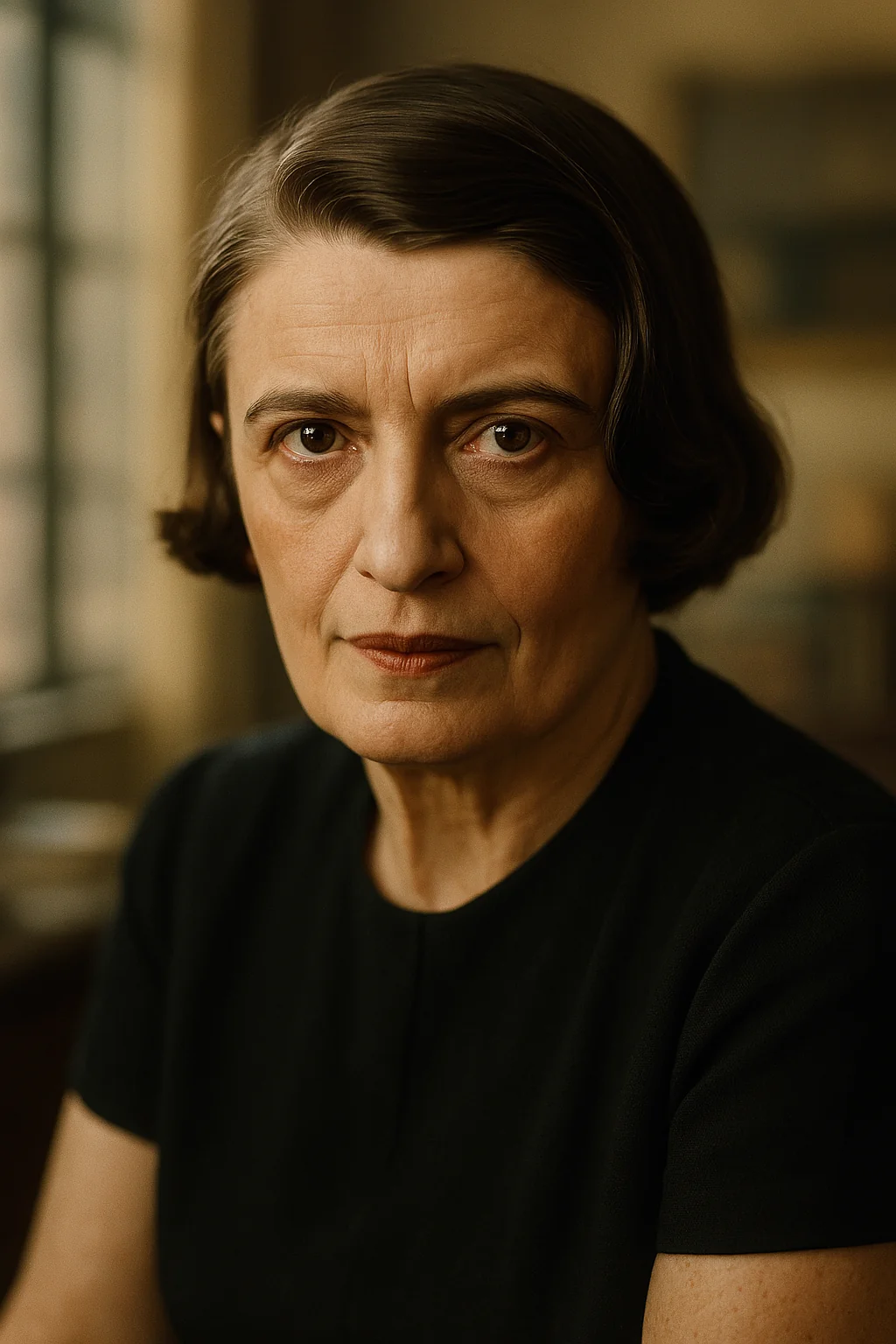
"“I often think that he's the only one of us who's achieved immortality. I don't mean in the sense of fame and I don't mean he won't die someday. But he's living it. I think he is what the conception really means. You know how people long to be eternal. But they die with everyday that passes. . . They change, they deny, they contradict- and they call it growth. At the end there is nothing left, nothing unreveresed or unbetrayed; as if there had never been an entity, only a succession of adjectives fading in and out of an unformed mass. How do they expect a permanence which they never held for a single moment? But Howard- one can imagine him living forever.”"
— Ayn Rand
I Often Think That Hes The Only One Of Us Whos
“I often think that he's the only one of us who's achieved immortality. I don't mean in the sense of fame and I don't mean he won't die someday. But he's living it. I think he is what the conception really means. You know how people long to be eternal. But they die with everyday that passes. . . They change, they deny, they contradict- and they call it growth. At the end there is nothing left, nothing unreveresed or unbetrayed; as if there had never been an entity, only a succession of adjectives fading in and out of an unformed mass. How do they expect a permanence which they never held for a single moment? But Howard- one can imagine him living forever.”
Similar Quotes
“The Thought of Death. It gives me a melancholy happiness to live in the midst of this confusion of streets, of necessities, of voices: how much enjoyment, impatience and desire, how much thirsty life and drunkenness of life comes to light here every moment! And yet it will soon be so still for all these shouting, lively, life- loving people! How everyone's shadow, his gloomy travelling companion stands behind him! It is always as in the last moment before the departure of an emigrant- ship: people have more than ever to say to one another, the hour presses, the ocean with its lonely silence waits impatiently behind all the noise-so greedy, so certain of its prey! And all, all, suppose that the past has been nothing, or a small matter, that the near future is everything: hence this haste, this crying, this self-deafening and self-overreaching! Everyone wants to be foremost in this future-and yet death and the stillness of death are the only things certain and common to all in this future! How strange that this sole thing that is certain and common to all, exercises almost no influence on men, and that they are the furthest from regarding themselves as the brotherhood of death! It makes me happy to see that men do not want to think at all of the idea of death! I would fain do something to make the idea of life to us to be more than friends in the sense of that sublime possibility. And so we will believe in our even a hundred times more worthy of their attention.”
“That which has died falls not out of the universe. If it stays here, it also changes here, and is dissolved into its proper parts, which are elements of the universe and of thyself. And these too change, and they murmur not".”
“Death does not concern us, because as long as we exist, death is not here. And when it does come, we no longer exist.”
“Time like space, is part of the permanent context of life. Time does not pass, we pass.”
“It sounds like a fairy-tale, but not only that; this story of what man by his science and practical inventions has achieved on this earth, where he first appeared as a weakly member of the animal kingdom, and on which each individual of his species must ever again appear as a helpless infant... is a direct fulfilment of all, or of most, of the dearest wishes in his fairy-tales. All these possessions he has acquired through culture. Long ago he formed an ideal conception of omnipotence and omniscience which he embodied in his gods. Whatever seemed unattainable to his desires - or forbidden to him - he attributed to these gods. One may say, therefore, that these gods were the ideals of his culture. Now he has himself approached very near to realizing this ideal, he has nearly become a god himself. But only, it is true, in the way that ideals are usually realized in the general experience of humanity. Not completely; in some respects not at all, in others only by halves. Man has become a god by means of artificial limbs, so to speak, quite magnificent when equipped with all his accessory organs; but they do not grow on him and they still give him trouble at times... Future ages will produce further great advances in this realm of culture, probably inconceivable now, and will increase man's likeness to a god still more.”
“I believe that if one man were to live out his life fully and completely, were to give form to every feeling, expression to every thought, reality to every dream - I believe that the world would gain such a fresh impulse of joy that we would forget all the maladies of medievalism, and return to the Hellenic ideal - to something finer, richer, than the Hellenic ideal, it may be. But the bravest man amongst us is afraid of himself. The mutilation of the savage has its tragic survival in the self-denial that mars our lives. We are punished for our refusals.”