
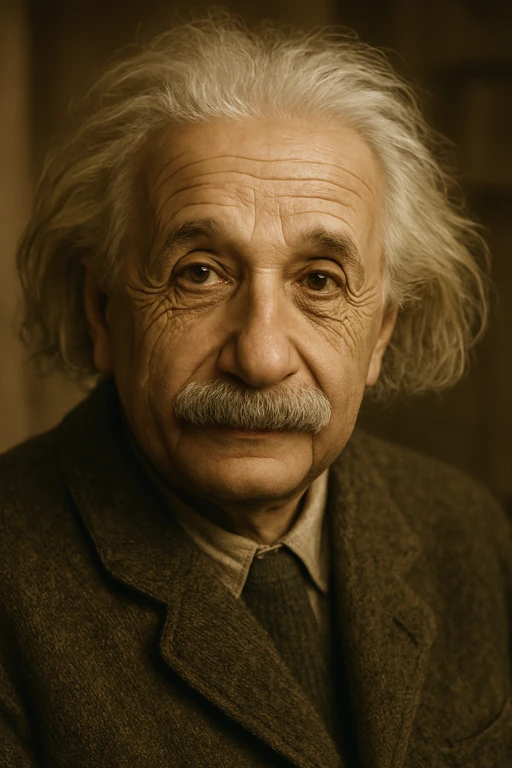
"One of the strongest motives that lead men to art and science is escape from everyday life with its painful crudity and hopeless dreariness, from the fetters of one's own ever-shifting desires. A finely tempered nature longs to escape from the personal life into the world of objective perception and thought."
— Albert Einstein
One Of The Strongest Motives That Lead Men To Art
One of the strongest motives that lead men to art and science is escape from everyday life with its painful crudity and hopeless dreariness, from the fetters of one's own ever-shifting desires. A finely tempered nature longs to escape from the personal life into the world of objective perception and thought.
Similar Quotes
“Those whose acquaintance with scientific research is derived chiefly from its practical results easily develop a completely false notion of the mentality of the men who, surrounded by a skeptical world, have shown the way to kindred spirits scattered wide through the world and through the centuries. Only one who has devoted his life to similar ends can have a vivid realization of what has inspired these men and given them the strength to remain true to their purpose in spite of countless failures. It is cosmic religious feeling that gives a man such strength. A contemporary has said, not unjustly, that in this materialistic age of ours the serious scientific workers are the only profoundly religious people.”
“No other technique for the conduct of life attaches the individual so firmly to reality as laying emphasis on work; for his work at least gives him a secure place in a portion of reality, in the human community. The possibility it offers of displacing a large amount of libidinal components, whether narcissistic, aggressive or even erotic, on to professional work and on to the human relations connected with it lends it a value by no means second to what it enjoys as something indispensible to the preservation and justification of existence in society. Professional activity is a source of special satisfaction if it is a freely chosen one — if, that is to say, by means of sublimation, it makes possible the use of existing inclinations, of persisting or constitutionally reinforced instinctual impulses. And yet, as a path to happiness, work is not highly prized by men. They do not strive after it as they do after other possibilities of satisfaction. The great majority of people only work under the stress of necessity, and this natural human aversion to work raises most difficult social problems.”
“In consequence, when the pleasures have been removed which busy people derive from their actual activities, the mind cannot endure the house, the solitude, the walls, and hates to observe its own isolation. From this arises that boredom and self-dissatisfaction, that turmoil of a restless mind and gloomy and grudging endurance of our leisure, especially when we are ashamed to admit the reasons for it and our sense of shame drives the agony inward, and our desires are trapped in narrow bounds without escape and stifle themselves. From this arise melancholy and mourning and a thousand vacillations of a wavering mind, buoyed up by the birth of hope and sickened by the death of it. From this arises the state of mind of those who loathe their own leisure and complain that they have nothing to do, and the bitterest envy at the promotion of others. For unproductive idleness nurtures malice, and because they themselves could not prosper they want everyone else to be ruined. Then from this dislike of others' success and despair of their own, their minds become enraged against fortune, complain about the times, retreat into obscurity, and brood over their own sufferings until they become sick and tired of themselves.”
All religions, arts and sciences are branches of the same tree. All these aspirations are directed toward ennobling man's life, lifting it from the sphere of mere physical existence and leading the individual towards freedom.
“I believe that if one man were to live out his life fully and completely, were to give form to every feeling, expression to every thought, reality to every dream - I believe that the world would gain such a fresh impulse of joy that we would forget all the maladies of medievalism, and return to the Hellenic ideal - to something finer, richer, than the Hellenic ideal, it may be. But the bravest man amongst us is afraid of himself. The mutilation of the savage has its tragic survival in the self-denial that mars our lives. We are punished for our refusals.”
“The advantage of the emotions is that they lead us astray, and the advantage of science is that it is not emotional.”