
Thomas Jefferson
Quotes & Wisdom
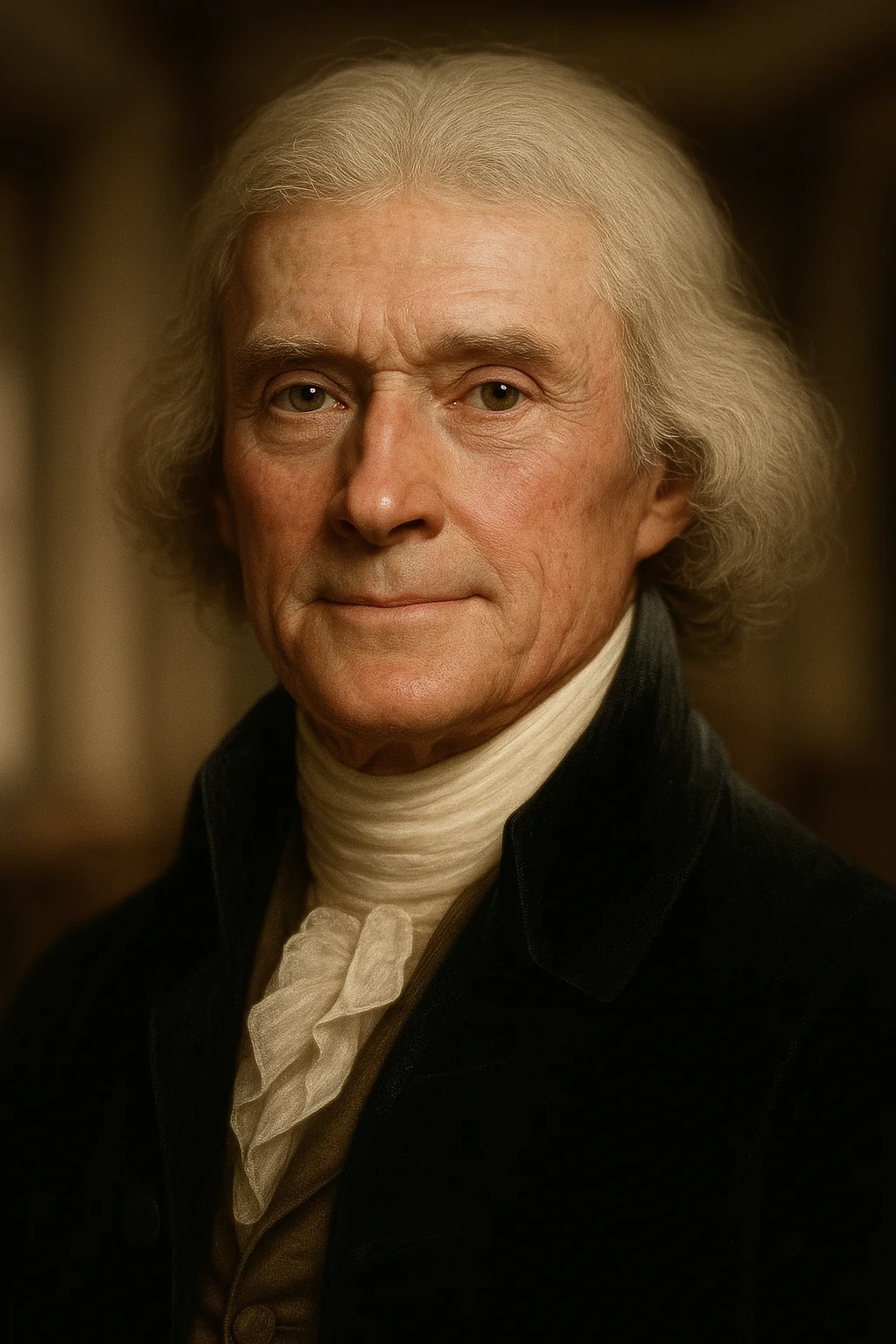
Thomas Jefferson authored the document that defined American aspirations - the Declaration of Independence, with its revolutionary claim that all men are created equal. Yet this architect of liberty owned over six hundred enslaved people across his lifetime, fathering children with Sally Hemings while never freeing her. This contradiction has made Jefferson both America's greatest apostle of freedom and its most troubling symbol of hypocrisy. Beyond politics, he was a polymath who designed buildings, founded a university, mastered multiple languages, and corresponded with the finest minds of his age. Understanding Jefferson requires holding his ideals and his failures in tension, neither dismissing the former nor excusing the latter.
Context & Background
Thomas Jefferson was born on April 13, 1743, at Shadwell plantation in Virginia's piedmont, into the colonial gentry that would produce so many revolutionary leaders. His father Peter was a successful planter and surveyor; his mother Jane Randolph came from one of Virginia's most prominent families. This world of plantations, enslaved labor, and English cultural aspiration was all young Thomas knew.
Colonial Virginia operated on a foundation of chattel slavery, tobacco cultivation, and deference to landed families. The same Enlightenment ideals that Jefferson would later deploy against British tyranny were circulating through Atlantic intellectual networks - John Locke on natural rights, Montesquieu on balanced government, the Scottish philosophers on moral sense. Jefferson absorbed these ideas at William and Mary College and in the study of law, synthesizing European thought for American conditions.
The 1760s and 1770s radicalized the Virginia gentry. British taxation seemed to threaten their self-government; Parliamentary assertions of authority looked like the beginnings of despotism. Jefferson entered politics with "A Summary View of the Rights of British America" (1774), an unusually bold argument for colonial autonomy that brought him to continental attention.
The Continental Congress assigned him the task of drafting the Declaration of Independence in June 1776 - not because he was the obvious choice (at thirty-three, he was relatively young and inexperienced) but because John Adams recognized his literary gifts. The document Jefferson produced, edited by the Congress, became America's founding scripture.
Jefferson believed in human reason, progress, and the capacity of ordinary people - by which he meant white male property owners - to govern themselves. His political philosophy blended Enlightenment optimism with agrarian republicanism: yeoman farmers, economically independent and rationally educated, would form the basis of a virtuous democracy.
His vision set him against the Federalists, particularly Alexander Hamilton, who favored a strong central government, national bank, and commercial development. Jefferson saw these as threats to liberty, seeds of aristocracy and corruption. As secretary of state under Washington and then as vice president under Adams, he organized the opposition that became the Democratic-Republican Party.
The presidency (1801-1809) brought compromises with ideals. The Louisiana Purchase, which doubled the nation's territory, required constitutional creativity to justify. The embargo against Britain and France devastated American commerce without achieving its diplomatic aims. Yet Jefferson remained committed to limited government, religious freedom, and the expansion of opportunity - at least for those he considered capable of exercising it.
His establishment of the University of Virginia in his retirement represented the educational ideals he had long championed: practical learning, religious tolerance, architectural beauty, and the training of citizens for self-government. He designed its grounds himself, creating what he called an "academical village" that remains one of America's architectural treasures.
No aspect of Jefferson's legacy troubles more deeply than his relationship to slavery. He knew it was wrong. He wrote that the institution created "unremitting despotism" on one side and "degrading submissions" on the other. He included a condemnation of the slave trade in his draft of the Declaration, removed by the Congress. He proposed gradual emancipation plans that went nowhere.
Yet he owned human beings throughout his life, buying and selling them, having them whipped, and pursuing those who escaped. He depended on their labor for his lifestyle. His sophisticated excuses - that emancipation required deportation to prevent race war, that his debts prevented manumission, that the time wasn't right - convinced himself and few others.
The Sally Hemings relationship forces the contradiction to its most personal point. Hemings, enslaved at Monticello, was almost certainly the half-sister of Jefferson's deceased wife Martha (they shared a father). DNA evidence and historical research have established that Jefferson fathered at least six children with her over nearly four decades. He freed only those children and a few other Hemings relatives; Sally herself was never formally freed.
Modern assessment cannot simply condemn or excuse. Jefferson's ideals helped end slavery even if he didn't live up to them; his failures remind us that even the best articulated principles require courage to implement. The tension is American history itself.
Jefferson's interests extended far beyond politics. He corresponded with scientists across Europe, sent Lewis and Clark to explore the West, and accumulated one of America's finest libraries - sold to Congress after the British burned the original Library of Congress in 1814. He invented a wheel cipher for codes, a polygraph for copying letters, and improved the plow with a mathematical moldboard design.
Architecture consumed him. He designed Monticello through decades of building and rebuilding, creating a unique synthesis of classical and modern elements. The Virginia State Capitol in Richmond, based on a Roman temple, pioneered neoclassical public architecture in America. The University of Virginia campus demonstrated his educational philosophy in physical form.
His religious views scandalized opponents who called him an atheist. Jefferson considered himself a rational Christian who admired Jesus as a moral teacher while rejecting miracles and orthodox theology. His "Jefferson Bible," assembled by cutting and pasting the Gospels to remove supernatural elements, reveals a Deist's approach to faith - reasonable, ethical, stripped of mystery.
His friendship and later rivalry with John Adams produced one of history's great correspondences when they reconciled in old age. The two founders, both having served as president, exchanged letters on philosophy, history, religion, and the meaning of their revolution. They died on the same day - July 4, 1826, the fiftieth anniversary of the Declaration's adoption.
Jefferson was tall and loose-jointed, with reddish hair and a diffident manner that contrasted with his bold writings. He disliked public speaking and rarely gave formal addresses, preferring the written word. His first inaugural address was delivered so quietly that many in the audience couldn't hear it.
He kept meticulous records - of weather, gardening experiments, finances, and correspondence. His garden book tracked plantings at Monticello over fifty years. His farm book recorded the lives, labors, and deaths of enslaved people with the same methodical attention.
His debts, accumulated through generosity, poor management, and expensive tastes, meant that his estate was sold after his death to satisfy creditors. The enslaved community at Monticello was dispersed at auction, families separated. The man who proclaimed liberty's ideals left human beings as property to be liquidated.
His epitaph, which he wrote himself, listed not his presidency or his revolutionary service but three achievements: author of the Declaration of Independence, author of the Virginia Statute for Religious Freedom, and father of the University of Virginia. These he considered his legacy - the ideas, the principles, the institutions that would outlast him. Whether they redeem or merely complicate his failures remains for each generation to decide.
Thomas Jefferson Quotes
Nothing gives one person so much advantage over another as to remain always cool and unruffled under all circumstances.
I have observed, indeed, generally, that while in protestant countries the defections from the Platonic Christianity of the priests is to Deism, in catholic countries they are to Atheism.
4. Religion. Your reason is now mature enough to examine this object. In the first place, divest yourself of all bias in favor of novelty & singularity of opinion... shake off all the fears & servile prejudices, under which weak minds are servilely crouched.
...legitimate powers of government reach actions only, & not opinions, I contemplate with sovereign reverence that act of the whole American people which declared that their legislature should 'make no law respecting an establishment of religion, or prohibiting the free exercise thereof,'
...vast accession of strength from their younger recruits, who having nothing in them of the feelings or principles of ’76 now look to a single and splendid government of an Aristocracy, founded on banking institutions and monied in corporations under the guise and cloak of their favored branches of manufactures commerce and navigation, riding and ruling over the plundered ploughman and beggared yeomanry.
I hold it that a little rebellion now and then is a good thing, and as necessary in the political world as storms in the physical. Unsuccesful rebellions indeed generally establish the incroachments on the rights of the people which have produced them. An observation of this truth should render honest republican governors so mild in their punishment of rebellions, as not to discourage them too much. It is a medecine necessary for the sound health of government.
I know no safe depository of the ultimate powers of the society but the people themselves ; and if we think them not enlightened enough to exercise their control with a wholesome discretion, the remedy is not to take it from them, but to inform their discretion by education. This is the true corrective of abuses of constitutional power.
And the day will come when the mystical generation of Jesus, by the supreme being as his father in the womb of a virgin will be classed with the fable of the generation of Minerva in the brain of Jupiter. But we may hope that the dawn of reason and freedom of thought in these United States will do away all this artificial scaffolding...
We took the liberty to make some enquiries concerning the ground of their pretensions to make war upon nations who had done them no injury, and observed that we considered all mankind as our friends who had done us no wrong, nor had given us any provocation.
I write nothing for publication, and last of all things should it be on the subject of religion.
...it is not to be understood that I am with him [Jesus] in all his doctrines. I am a Materialist, he takes the side of spiritualism; he preaches the efficacy of repentance toward forgiveness of sin. I require a counterpoise of good works to redeem it... Among the sayings & discourses imputed to him by his biographers, I find many passages of fine imagination, correct morality, and of the most lovely benevolence: and others again of so much ignorance, so much absurdity, so much untruth, charlatanism, and imposture, as to pronounce it impossible that such contradictions should have proceeded from the same being.
I am not an advocate for frequent changes in laws and Constitutions. But laws and institutions must go hand in hand with the progress of the human mind. As that becomes more developed, more enlightened, as new discoveries are made, new truths discovered and manners and opinions change, with the change of circumstances, institutions must advance also to keep pace with the times. We might as well require a man to wear still the coat which fitted him when a boy as civilized society to remain ever under the regimen of their barbarous ancestors.
Some are whigs, liberals, democrats, call them what you please. Others are tories, serviles, aristocrats, &c. The latter fear the people, and wish to transfer all power to the higher classes of society; the former consider the people as the safest depository of power in the last resort; they cherish them therefore, and wish to leave in them all the powers to the exercise of which they are competent.
The hocus-pocus phantasm of a God like another Cerberus, with one body and three heads, had its birth and growth in the blood of thousands and thousands of martyrs... In fact, the Athanasian paradox that one is three, and three but one, is so incomprehensible to the human mind, that no candid man can say he has any idea of it, and how can he believe what presents no idea? He who thinks he does, only deceives himself. He proves, also, that
The whole art of government consists in the art of being honest.
A Decalogue of Canons for Observation in Practical Life:
It is an axiom in my mind, that our liberty can never be safe but in the hands of the people themselves, and that too of the people with a certain degree of instruction. This it is the business of the State to effect, and on a general plan.
I wish that all nations may recover and retain their independence; that those which are overgrown may not advance beyond safe measures of power, that a salutary balance may be ever maintained among nations, and that our peace, commerce, and friendship, may be sought and cultivated by all. It is our business to manufacture for ourselves whatever we can, to keep our markets open for what we can spare or want; and the less we have to do with the amities or enmities of Europe, the better. Not in our day, but at no distant one, we may shake a rod over the heads of all, which may make the stoutest of them tremble.
The people cannot be all, and always, well informed. The part which is wrong will be discontented, in proportion to the importance of the facts they misconceive. If they remain quiet under such misconceptions, it is lethargy, the forerunner of death to the public liberty. ... What country before ever existed a century and half without a rebellion? And what country can preserve its liberties if their rulers are not warned from time to time that their people preserve the spirit of resistance? Let them take arms. The remedy is to set them right as to facts, pardon and pacify them. What signify a few lives lost in a century or two? The tree of liberty must be refreshed from time to time with the blood of patriots and tyrants. It is its natural manure.
I had rather be shut up in a very modest cottage with my books, my family and a few old friends, dining on simple bacon, and letting the world roll on as it liked, than to occupy the most splendid post, which any human power can give.
Whereas it appeareth that however certain forms of government are better calculated than others to protect individuals in the free exercise of their natural rights, and are at the same time themselves better guarded against degeneracy, yet experience hath shewn, that even under the best forms, those entrusted with power have, in time, and by slow operations, perverted it into tyranny; and it is believed that the most effectual means of preventing this would be, to illuminate, as far as practicable, the minds of the people at large, ....whence it becomes expedient for promoting the publick happiness that those persons, whom nature hath endowed with genius and virtue, should be rendered by liberal education worthy to receive, and able to guard the sacred deposit of the rights and liberties of their fellow citizens, and that they should be called to that charge without regard to wealth, birth or accidental condition of circumstance.
And to preserve their independence, we must not let our rulers load us with perpetual debt. We must make our election between economy and liberty, or profusion and servitude. If we run into such debts, as that we must be taxed in our meat and in our drink, in our necessaries and our comforts, in our labors and our amusements, for our callings and our creeds, as the people of England are, our people, like them, must come to labor sixteen hours in the twenty-four, give the earnings of fifteen of these to the government for their debts and daily expenses; and the sixteenth being insufficient to afford us bread, we must live, as they now do, on oatmeal and potatoes; have no time to think, no means of calling the mismanagers to account; but be glad to obtain subsistence by hiring ourselves to rivet their chains on the necks of our fellow-sufferers.
Altho' I rarely waste time in reading on theological subjects, as mangled by our Pseudo-Christians, yet I can readily suppose Basanistos may be amusing. Ridicule is the only weapon which can be used against unintelligible propositions. Ideas must be distinct before reason can act upon them; and no man ever had a distinct idea of the trinity. It is mere Abracadabra of the mountebanks calling themselves the priests of Jesus. If it could be understood it would not answer their purpose. Their security is in their faculty of shedding darkness, like the scuttlefish, thro' the element in which they move, and making it impenetrable to the eye of a pursuing enemy, and there they will skulk.
When we see religion split into so many thousand of sects, and I may say Christianity itself divided into its thousands also, who are disputing, anathematizing and where the laws permit burning and torturing one another for abstractions which no one of them understand, and which are indeed beyond the comprehension of the human mind, into which of the chambers of this Bedlam would a man wish to thrust himself.
But friendship is precious, not only in the shade but in the sunshine of life; & thanks to a benevolent arrangement of things, the greater part of life is sunshine. I will recur for proof to the days we have lately passed. On these indeed the sun shone brightly.
May it [American independence] be to the world, what I believe it will be, (to some parts sooner, to others later, but finally to all,) the signal of arousing men to burst the chains under which monkish ignorance and superstition had persuaded them to bind themselves, and to assume the blessings and security of self-government. That form which we have substituted, restores the free right to the unbounded exercise of reason and freedom of opinion. All eyes are opened, or opening, to the rights of man. The general spread of the light of science has already laid open to every view the palpable truth, that the mass of mankind has not been born with saddles on their backs, nor a favored few booted and spurred, ready to ride them legitimately... These are grounds of hope for others. For ourselves, let the annual return of this day forever refresh our recollections of these rights, and an undiminished devotion to them.
I cannot live without books.
Do you want to know who you are? Don't ask. Act! Action will delineate and define you.
Honesty is the first chapter of the book wisdom.
The man who reads nothing at all is better educated than the man who reads nothing but newspapers.
On matters of style, swim with the current, on matters of principle, stand like a rock.
I'm a greater believer in luck, and I find the harder I work the more I have of it.
We in America do not have government by the majority. We have government by the majority who participate.
I would rather be exposed to the inconveniences attending too much liberty than to those attending too small a degree of it.
History, in general, only informs us what bad government is.
If a nation expects to be ignorant and free, in a state of civilization, it expects what never was and never will be.
I agree with yours of the 22d that
When the clergy addressed
There is nothing more unequal than the equal treatment of unequal people.
As you say of yourself, I too am an
If you want something you've never had
When once we quit the basis of sensation, all is in the wind. To talk of
I think one travels more usefully when they travel alone, because they reflect more."
The equal rights of man, and the happiness of every individual, are now acknowledged to be the only legitimate objects of government.
Timid men prefer the calm of despotism to the tempestuous sea of Liberty.
When injustice becomes law, resistance becomes duty.
Do not bite at the bait of pleasure till you know there is no hook beneath it.
Tyranny is defined as that which is legal for the government but illegal for the citizenry.
The legitimate powers of government extend to such acts only as are injurious to others. It does me no injury for my neighbor to say there are twenty gods or no god. It neither picks my pocket nor breaks my leg.
I sincerely believe that banking establishments are more dangerous than standing armies, and that the principle of spending money to be paid by posterity, under the name of funding, is but swindling futurity on a large scale.
The most valuable of all talents is that of never using two words when one will do.
Difference of opinion is advantageous in religion. The several sects perform the office of a Censor morum over each other. Is uniformity attainable?
“It be urged that the wild and uncultivated tree, hitherto yielding sour and bitter fruit only, can never be made to yield better; yet we know that the grafting art implants a new tree on the savage stock, producing what is most estimable in kind and degree. Education, in like manner, engrafts a new man on the native stock, and improves what in his nature was vicious and perverse into qualities of virtue and social worth.”
“Speaking one day to Monsieur de Buffon, on the present ardor of chemical inquiry, he affected to consider chemistry but as cookery, and to place the toils of the laboratory on the footing with those of the kitchen. I think it, on the contrary, among the most useful of sciences, and big with future discoveries for the utility and safety of the human race.”
“The attempt of Lavoisier to reform chemical nomenclature is premature. One single experiment may destroy the whole filiation of his terms; and his string of sulphates, sulphites, and sulphures, may have served no end than to have retarded the progress of science by a jargon, from the confusion of which time will be requisite to extricate us.”
“You have heard of the new chemical nomenclature endeavored to be introduced by Lavoisier, Fourcroy, &c. Other chemists of this country, of equal note, reject it, and prove in my opinion that it is premature, insufficient and false. These latter are joined by the British chemists; and upon the whole, I think the new nomenclature will be rejected, after doing more harm than good. There are some good publications in it, which must be translated into the ordinary chemical language before they will be useful.”
“I [am] obliged to recur ultimately to my habitual anodyne, "I feel: therefore I exist." I feel bodies which are not myself: there are other existencies then. I call them "matter". I feel them changing place. This gives me "motion". Where there is an absence of matter, I call it "void", or "nothing", or "immaterial space". On the basis of sensation, of matter and motion, we may erect the fabric of all the certainties we can have or need.”
“Nature intended me for the tranquil pursuits of science, by rendering them my supreme delight. But the enormities of the times in which I have lived, have forced me to take a part in resisting them, and to commit myself on the boisterous ocean of political passions.”
“No government ought to be without censors: and where the press is free, no one ever will. If virtuous, it need not fear the fair operation of attack and defence. Nature has given to man no other means of sifting out the truth either in religion, law, or politics. I think it as honorable to the government neither to know, nor notice, it’s sycophants or censors, as it would be undignified and criminal to pamper the former and persecute the latter.”
“I haven't failed. I've just found 10,000 ways that don't work.”
“Our civil rights have no dependence on our religious opinions any more than our opinions in physics or geometry...”
“Of all the cankers of human happiness, none corrodes it with so silent, yet so baneful, a tooth, as indolence.”
“They (religions) dread the advance of science as witches do the approach of daylight and scowl on the fatal harbinger announcing the subversions of the duperies on which they live.”
“Freedom, the first-born of science.”
“While the art of printing is left to us science can never be retrograde; what is once acquired of real knowledge can never be lost.”
“I have no ambition to govern men; it is a painful and thankless office.”
“Reason and free inquiry are the only effectual agents against error.”
“Even in Europe a change has sensibly taken place in the mind of man. Science has liberated the ideas of those who read and reflect, and the American example has kindled feelings of right in the people.”
“Nothing can now be believed which is seen in a newspaper. Truth itself becomes suspicious by being put into that polluted vehicle.”
“I was bold in the pursuit of knowledge, never fearing to follow truth and reason to whatever results they led.”
“… the man who never looks into a newspaper is better informed than he who reads them, inasmuch as he who knows nothing is nearer to truth than he whose mind is filled with falsehoods and errors.”
“All should be laid open to you without reserve, for there is not a truth existing which I fear, or would wish unknown to the whole world.”
“All are dead, and ourselves left alone amidst a new generation whom we know not, and who know us not.”
“The more ignorant we become the less value we set on science, and the less inclination we shall have to seek it.”
“Determine never to be idle. No person will have occasion to complain of the want of time, who never loses any. It is wonderful how much may be done, if we are always doing.”
“It is error alone which needs the support of government. Truth can stand by itself.”