
Napoleon Bonaparte
Quotes & Wisdom
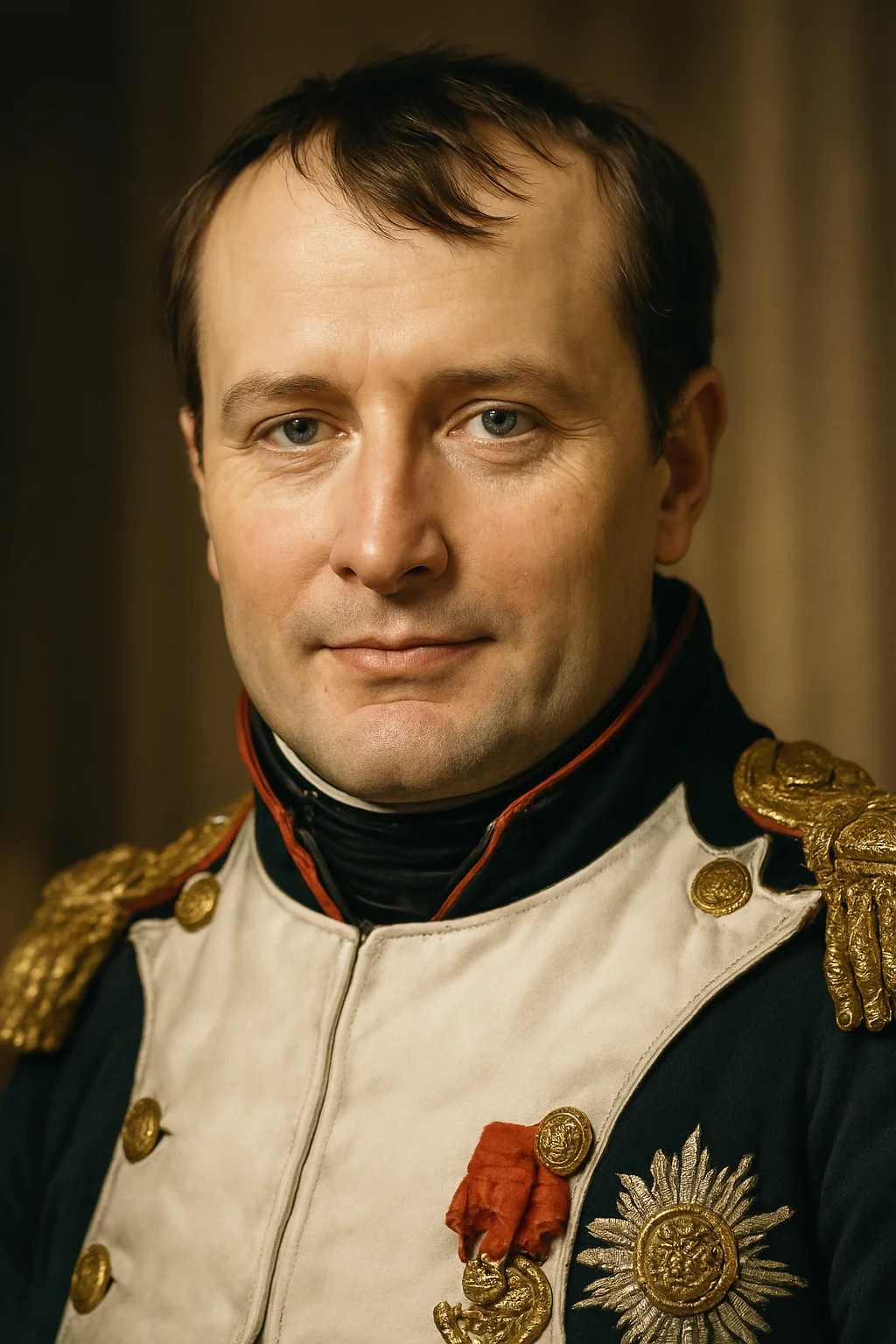
Napoleon Bonaparte reshaped Europe through military genius and political audacity, rising from minor Corsican nobility to become Emperor of the French and master of a continent. His campaigns redrew maps, toppled dynasties, and spread revolutionary ideals through conquest. The Napoleonic Code, his legal legacy, influenced legal systems worldwide. Yet his ambition also produced catastrophic wars that killed millions and ultimately led to his exile and lonely death on a remote Atlantic island. Whether liberator or tyrant, genius or megalomaniac, Napoleon remains history's most compelling example of how a single individual's will can reshape the world - and how the world eventually reshapes such individuals in return.
Context & Background
Napoleone di Buonaparte was born on August 15, 1769, in Ajaccio, Corsica, just fifteen months after the island's annexation by France. His family belonged to minor Italian-Corsican nobility - respectable but not wealthy. His father's collaboration with French authorities secured young Napoleon a scholarship to military school on the mainland, where his Corsican accent and provincial manners marked him as an outsider.
Revolutionary France offered ambitious men opportunities that the old regime had reserved for aristocrats. When the Revolution began in 1789, Lieutenant Bonaparte was a marginal figure; by 1799, he had become First Consul, effectively ruler of France. The decade between saw his rise through military brilliance, political opportunism, and sheer force of personality.
The siege of Toulon in 1793 first brought him prominence - his artillery tactics recovered the port from British-supported royalists. The "whiff of grapeshot" that dispersed a royalist mob in Paris in 1795 secured his reputation and his marriage to Josephine de Beauharnais, the elegant widow who would be his first empress.
The Italian campaigns of 1796-97 revealed his genius for war: rapid movement, concentration of force at decisive points, and the morale that his presence inspired in troops. At twenty-seven, he had conquered northern Italy, established puppet republics, and forced Austria to sue for peace. The Egyptian expedition that followed, though militarily unsuccessful, added oriental mystique to his legend.
The coup of 18 Brumaire (November 9, 1799) made Napoleon First Consul, then Consul for Life, and finally, in 1804, Emperor of the French. Each step consolidated power while maintaining revolutionary rhetoric about the people's will.
His domestic achievements rivaled his military ones. The Napoleonic Code systematized French law, establishing principles of equality before the law, property rights, and secular governance that spread across Europe and influenced legal systems on every continent. The Bank of France stabilized the currency; the Concordat with the Pope settled religious conflicts; educational reforms created the lycee system.
Yet these reforms served centralization and control. The secret police monitored dissent; censorship muzzled the press; the "continental system" tried to strangle British trade at the cost of economic distress. Napoleon's reforms were real, but so was his authoritarianism.
His coronation in Notre-Dame, where he famously placed the crown on his own head rather than accepting it from the Pope, symbolized his relationship with legitimacy. He drew authority from revolutionary principles but expressed it in imperial forms. The tension between these never resolved.
Napoleon's military campaigns from 1805 to 1812 produced some of history's most studied battles. Austerlitz (1805) destroyed the Third Coalition through a masterpiece of deception and timing. Jena-Auerstedt (1806) shattered Prussia in a single day. Wagram (1809) forced Austria to submit once more.
His operational genius combined strategic vision with tactical flexibility. He moved armies faster than opponents believed possible, concentrated superior force at the decisive point, and exploited victory ruthlessly. The corps system, the use of artillery as a mass weapon, and the integration of all arms set standards that military professionals still study.
But hubris followed triumph. The Peninsular War in Spain became a bleeding ulcer, tying down hundreds of thousands of troops in a guerrilla conflict that could not be won. The invasion of Russia in 1812 brought the Grand Army of 600,000 to Moscow - and brought perhaps 100,000 back, the rest dead from battle, cold, starvation, and disease.
The campaigns of 1813-14 showed Napoleon's tactical brilliance undiminished even as strategic reality closed in. He won battles but could not win the war. Paris fell; he abdicated; the allies exiled him to Elba. His escape, return, and final defeat at Waterloo in 1815 produced the Hundred Days - one last burst of drama before the curtain fell.
The British exiled Napoleon to St. Helena, a volcanic island in the South Atlantic, two thousand miles from anywhere. He would spend his last six years there, dictating memoirs, quarreling with his British jailer, and crafting the legend that would shape his posthumous reputation.
The "Memorial of St. Helena," recorded by Las Cases, presented Napoleon as the champion of revolutionary principles betrayed by reactionary monarchs, the unifier of Europe thwarted by British jealousy. This narrative, however self-serving, influenced generations of admirers from Ludwig van Beethoven (who initially dedicated the Eroica symphony to him) to twentieth-century strongmen who saw themselves as his heirs.
He died on May 5, 1821, probably of stomach cancer, though arsenic poisoning theories persist. His body was returned to France in 1840, interred beneath the dome of Les Invalides in Paris, where visitors still queue to see the red porphyry sarcophagus containing the remains of the little Corsican who conquered a continent.
Napoleon was famously short - except he wasn't, really. At five feet six inches by French measurement of the time, he was average height; British propaganda and confusion over measurement systems created the enduring myth of the "little corporal." What was unusual was his energy. He could work eighteen-hour days, dictate to multiple secretaries simultaneously, and sleep in fifteen-minute increments when campaigns demanded.
His personal relationships were complicated. Josephine remained his great love even after he divorced her for her inability to produce an heir. His second marriage to the Austrian archduchess Marie Louise was political; their son, styled King of Rome, would die young in Vienna. Brothers and sisters were installed as puppet monarchs across Europe, with decidedly mixed results.
He read voraciously - history, mathematics, law - and corresponded with scientists and scholars. He took savants to Egypt, founded the Institut d'Egypte, and retained genuine intellectual interests throughout his life. The man who reshaped Europe through war was also, paradoxically, a creature of the Enlightenment.
His legacy remains contested. Did he spread revolutionary ideals or betray them? Did he modernize Europe or devastate it? The millions of dead, the nations remade, the legal and administrative structures that endured - all these invite judgments that depend as much on the judge as on the evidence. What's clear is that for two decades, one man's will shaped history in ways that seemed impossible before and have rarely been matched since.
Napoleon Bonaparte Quotes
This soldier, I realized, must have had friends at home and in his regiment; yet he lay there deserted by all except his dog. I looked on, unmoved, at battles which decided the future of nations. Tearless, I had given orders which brought death to thousands. Yet here I was stirred, profoundly stirred, stirred to tears. And by what? By the grief of one dog.'
Men are Moved by two levers only: fear and self interest.
The world suffers a lot. Not because the violence of bad people. But because of the silence of the good people.
When a government is dependent upon bankers for money, they and not the leaders of the government control the situation, since the hand that gives is above the hand that takes. Money has no motherland; financiers are without patriotism and without decency; their sole object is gain.
Throw off your worries when you throw off your clothes at night.
Never tell your enemy he is doing the wrong thing.
The hand that gives is among the hand that takes. Money has no fatherland, financiers are without patriotism and without decency, their sole object is gain.
A true man hates no one.
Never interrupt your enemy when he is making a mistake.
Courage isn't having the strength to go on - it is going on when you don't have strength.
Religion is excellent stuff for keeping common people quiet. Religion is what keeps the poor from murdering the rich.
Show me a family of readers, and I will show you the people who move the world.
History is a set of lies agreed upon.
Imagination governs the world.
Nothing is more difficult, and therefore more precious, than to be able to decide.
History is written by the winners.
Take time to deliberate, but when the time for action comes, stop thinking and go in.
Impossible is a word to be found only in the dictionary of fools.
Men are more easily governed through their vices than through their virtues.
Circumstances-what are circumstances? I make circumstances
Ability is of little account without opportunity.
As for me, to love you alone, to make you happy, to do nothing which would contradict your wishes, this is my destiny and the meaning of my life.
Victory belongs to the most persevering.
Music is what tell us that the human race is greater than we realize.
Four hostile newspapers are more to be feared than a thousand bayonets..
The surest way to remain poor is to be honest.
History is the version of past events that people have decided to agree upon.
To understand the man you have to know what was happening in the world when he was twenty.
Great men are meteors designed to burn so that earth may be lighted.
In politics, stupidity is not a handicap.
If you want a thing done well, do it yourself.
A leader is a dealer in hope.
Alexander, Caesar, Charlemagne, and I have founded empires. But on what did we rest the creations of our genius? Upon force. Jesus Christ founded his empire upon love; and at this hour millions of men would die for him.
A picture is worth a thousand words.
If I had to choose a religion, the sun as the universal giver of life would be my god.
The only victories which leave no regret are those which are gained over ignorance.
You don't reason with intellectuals. You shoot them.
The best way to keep one's word is not to give it.
Conquests will come and go but
There are but two powers in the world, the sword and the mind. In the long run the sword is always beaten by the mind
The reason most people fail instead of succeed is they trade what they want most for what they want at the moment.
He who fears being conquered is sure of defeat.
China is a sleeping giant; let him sleep, for if he wakes, he will shake the World.
Death is nothing, but to live defeated and inglorious is to die daily.
Ten people who speak make more noise than ten thousand who are silent.
It is the cause, not the death, that makes the martyr.
“A woman laughing is a woman conquered.”